Elimination Round
After the qualification round, permanent alliances are formed and play a double-elimination bracket to determine the event winners.
Alliance Selection
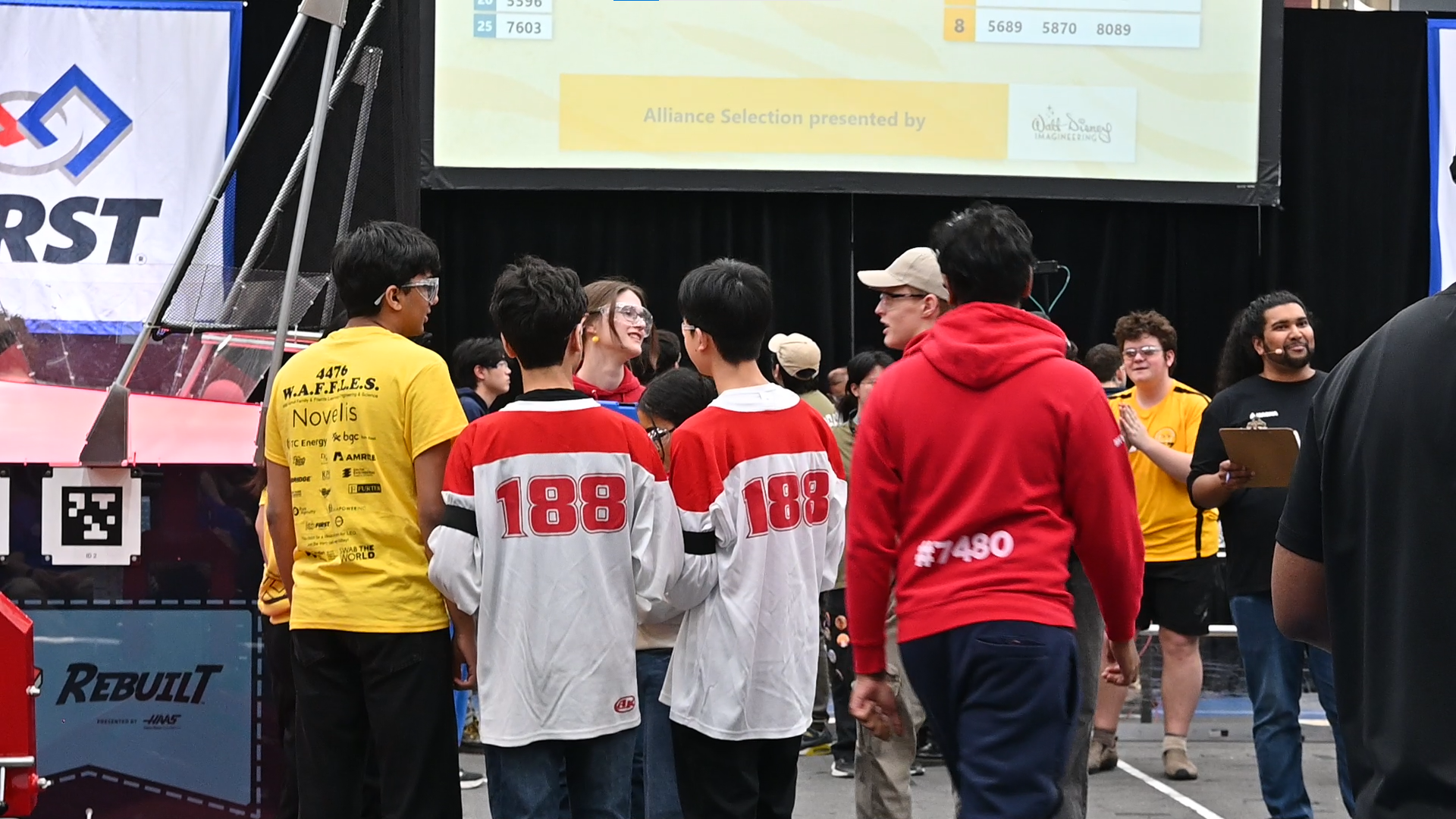
The playoff alliances are formed through the Alliance Selection process. It works very similar to a schoolyard pick.
The first-seed team (whoever got the highest RPA at the end of qualifications) may invite any team to join their alliance. If they accept, they're playing together for the rest of the event. They may decline, and first seed gets to pick again, but once a team has declined they cannot accept another invitation, and may only be captains.
This process repeats until there are 8 alliances, with a captain and first pick each. Now we work backwards, with the 8th alliance picking their third robot, then 7, 6, 5, and so forth. The final robot picked is the 1st alliance's third team.
This will all make more sense once you've seen it a few times, but there are a few key takeaways:
- Captains pick in qualification ranking order
- Declining is an option, but can be risky
- Being picked last can have a better chance of winning than being picked in the middle
Double-Elimination Bracket
Once the alliances are decided, they play through a double-elimination bracket. The opening round matches are stacked so the strongest alliances play the weakest, but as the bracket goes on things get jumbled and anyone could play anyone.
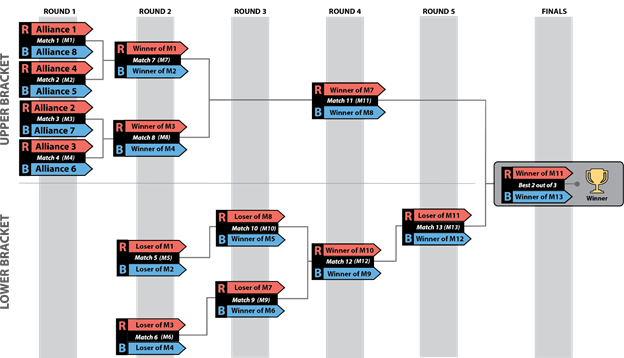
The rules are the same as in qualifications, but now ranking points are irrelevant and all that matters is who wins the match. A loss in the upper bracket will demote a team down to the lower bracket, and a second loss will eliminate them (hence the name double-elimination).
There is a notable difference with double-elim brackets from other competitions: For finals, the past performance is reset and it's a simple best 2-out-of-3.